Excavations 1953
The excavations of the mithraeum by John Pearson Gillam, Iain MacIvor and Eric B Birley is detailed in the 54-page report published in Archaeologia Aeliana series 4, volume 32, page 176-219, 1954.
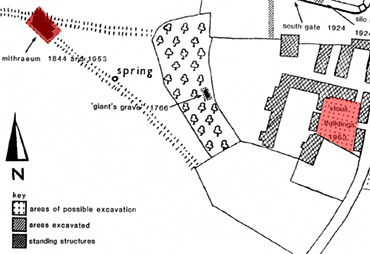
The Roman fort at Rudchester, located along Hadrian’s Wall in Northumberland, was the site of a Mithraeum — a temple dedicated to the god Mithras — discovered in 1844 when five altars were unearthed by workmen. Though a statue was unfortunately destroyed, the altars were preserved thanks to landowner Thomas James and later donated to the Society of Antiquaries. Their inscriptions confirmed the worship of Mithras at the site.
Excavations 1953
Click here for a high resolution scan in a new window:

View of Mithraeum looking West
Click here for a high resolution scan in a new window:

Gillam 1954
Click here for a high resolution scan in a new window:
The exact location of the temple was debated for decades, with early researchers wrongly associating it with nearby Roman features like a carved rock cistern (the “giant’s grave”) and a spring. In 1953, archaeologists J.P. Gillam and I. MacIvor used historical maps and field evidence to relocate and fully excavate the temple site.
The Mithraeum had two major phases. The first, Mithraeum I, featured a central nave flanked by benches, an apse at the west end, and a narthex (entrance area). It was roughly built on sloping ground, and one corner was constructed directly over a deep pre-existing pit. This led to eventual subsidence and collapse. The second phase, Mithraeum II, rebuilt the nave without the narthex and made structural improvements, including more symmetrical features and likely a large relief of Mithras in the apse.
Artifacts recovered included altars, torchbearer statue heads, pottery, lamps, and a laver. The temple was likely abandoned in the early 4th century and later desecrated, robbed, and damaged by ploughing. Nonetheless, the excavation confirmed key aspects of Roman frontier religion, showing how Mithraic worship was adapted in a military context. The Rudchester Mithraeum remains one of the most thoroughly studied Mithraic sites in Britain and offers valuable insight into the religious life of Roman soldiers stationed along Hadrian’s Wall.
I have not yet been able to find any information of the excavations on the drive.